

About us
Karlshochschule combines business, society, and culture to create an international and practice-oriented study program.
Contact
- Karlstraße 36 – 38, 76133 Karlsruhe, DE
- +49 721 48095 0
- info@karlshochschule.de
- Mo. – Fr. 8:30 – 17:00 Uhr
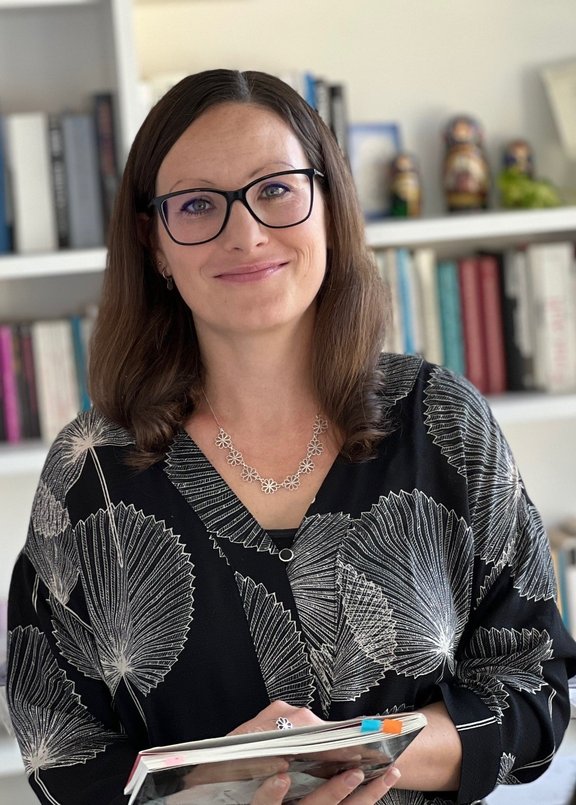
Prof. Dr. Bernadette Loacker
Professor of Management and Organisation Studies
Bernadette studies what work does to people. Not job satisfaction in the survey sense, but something harder to measure: how the way we organise labour shapes who we understand ourselves to be. Her research has followed artists into precarious freelance careers, management graduates into corporate roles, academics into performance measurement regimes — asking in each case what kind of person the work requires you to become, and what it costs to comply.
The creative worker as a test case
Her monograph Kreativ prekär examined artistic work as an early indicator of something now widespread: employment that promises autonomy and self-realisation while delivering insecurity. Artists, she argued, were held up as models of the flexible, self-driven worker long before that model reached everyone else. The work is not nostalgic about the old employment contract — it asks a sharper question about what freedom means when self-management becomes compulsory. Students in her modules on employment relations and the organisation of work start from exactly there.
Power, ethics and the subject at work
Bernadette works within critical management studies, drawing on poststructuralist thought to examine how organisational power operates less through orders than through the identities it makes available. Her published work covers the ethics of responsiveness, whistleblowing and its politics, gender inequality in academic careers, and the discursive codes that shape how graduates understand their own trajectories. She has been part of the editorial collective of ephemera: theory & politics in organization for years, and co-edited special issues there on the commons, mobility and the consumption of work.
A therapist's ear for organisational life
Alongside her academic training, Bernadette trained as a systemic psychotherapist and worked in several psychosocial institutions. This is not a footnote to the research. It shapes how she conducts qualitative fieldwork, how she reads what people say about their working lives, and how she teaches leadership theory — with attention to what is happening in a room rather than only to the model on the slide. Few management scholars bring that combination.
An international academic path
Bernadette studied social and economic sciences at the University of Innsbruck, where she also completed her PhD in management and organisation. She held positions at WU Vienna, at Lund University in Sweden, and as Associate Professor in the Department of Organisation, Work and Technology at Lancaster University in the UK before joining Karlshochschule in January 2022. She teaches managing people, organisational behaviour and change, leadership theory, research methodology and study skills — and supervises theses in all of them.
Work no longer just asks what you can do. It asks who you are willing to be.
Facts, figures and the full CV
Role
- At the university since January 2022
Focus on teaching
- Managing People
- Employment relations and the organisation of work
- Organisational change and learning
- Leadership theories
- Organisational behaviour and organisation theory
- Methodology and empirical social research
- Study skills
Research interests and fields
- Critical management and organisation theory
- Changes in the organisation of work
- Processes of professional identity and subjectivity formation
- Societal and organisational power relations
- Ethical practices in organisations
- Creativity and organisation
- Qualitative social research
Academic background and positions
- Associate Professor, Department of Organisation, Work and Technology, Lancaster University, UK
- Postdoctoral Researcher and Lecturer, Department of Business Administration, Management & Organisation Studies Group, Lund University, Sweden
- Assistant Professor, Department of Management, WU Vienna, Austria
- Research Assistant, Institute of Organisation and Learning, University of Innsbruck, Austria
- PhD in Management and Organisation, University of Innsbruck, Austria
- Studies in Social and Economic Sciences, University of Innsbruck, Austria
Practical experience
- Training as a systemic psychotherapist
- Work experience in several psychosocial institutions
- Freelance teaching at various European universities
Further information
- Member of the international editorial collective of the open-access journal ephemera: theory & politics in organization
- Member of professional bodies including the European Group for Organisational Studies (EGOS) and the Standing Conference on Organisational Symbolism (SCOS)
- Regular reviewer for journals in management and organisation research
- Regular conference and public event participation
Publications (selection)
-
Monograph
- Loacker, B. (2010). ‘Kreativ prekär’: Künstlerische Arbeit und Subjektivität im Postfordismus. Bielefeld: transcript, 304 pp.
Peer-reviewed journal articles
- Loacker, B. (2021). Entrepreneurship and the struggle over order and coherence: A thematic reading of Robert Musil’s The Man without Qualities. Culture and Organization.
- Jeanes, E., Loacker, B. & Sliwa, M. (2019). Complexities, challenges and implications of collaborative work within a regime of performance measurement. Studies in Higher Education, 44(9), 1539–1553.
- Loacker, B. & Sliwa, M. (2018). Beyond bureaucracy and entrepreneurialism: Examining the multiple discursive codes informing the work, careers and subjectivities of management graduates. Culture and Organization, 24(5), 426–450.
- Jeanes, E., Loacker, B. & Sliwa, M. (2018). Revisiting struggles over gender inequalities: An account of three academics. M@n@gement, 21(3), 1100–1104.
- Loacker, B. & Sliwa, M. (2016). ‘Moving to stay in the same place?’ Academics and theatrical artists as exemplars of the ‘mobile middle’. Organization, 23(5), 657–679.
- Loacker, B. & Sullivan, R. (2016). The liminality of branding: Interweaving discourses ‘making up’ a cultural intermediary occupation. Marketing Theory, 16(3), 361–382.
- Loacker, B. & Peters, L. (2015). ‘Come on, get happy!’: Exploring absurdity and sites of alternate ordering in Twin Peaks. ephemera, 15(3), 621–649.
- Kattenbach, R., Schneidhofer, T., Latzke, M., Loacker, B., Lücke, J., Schramm, F. & Mayrhofer, W. (2014). A quarter of a century of job transitions in Germany. Journal of Vocational Behavior, 84, 49–58.
- Loacker, B. (2013). Modulated power structures in the arts and their subjectivity-constituting effects. Business and Professional Ethics Journal, 32(2), 21–48.
- Loacker, B. (2013). Becoming culturpreneur: How the neoliberal ‘regime of truth’ affects and redefines artistic subject positions. Culture and Organization, 19(2), 124–145.
- Loacker, B. & Muhr, S. L. (2009). ‘How can I become a responsible subject?’ Towards a practice-based ethics of responsiveness. Journal of Business Ethics, 90(2), 265–277.
- Weiskopf, R. & Loacker, B. (2006). ‘A snake’s coils are even more intricate than a mole’s burrow’: Individualization and subjectivation in postdisciplinary regimes of work. Management Review, 17(4), 395–419.
Edited special issues
- Loacker, B., Heinrichs, R. & Weiskopf, R. (eds.) (2019). Speaking truth to power? The ethico-politics of whistleblowing in mass-mediated societies. ephemera, 19(4).
- Chertkovskaya, E. & Loacker, B. (eds.) (2016). Consumption of work and the work of consumption. ephemera, 16(3).
- Jeanes, E., Loacker, B., Sliwa, M. & Weiskopf, R. (eds.) (2015). Mobilities in contemporary worlds of work and organising. ephemera, 15(4).
- Hoedemaekers, C., Loacker, B. & Pedersen, M. (eds.) (2012). The commons and their im/possibilities. ephemera, 12(4).
Selected book chapters
- Alvesson, M. & Loacker, B. (2016). Critical management studies. In Dahlgaard-Park (ed.), The SAGE Encyclopedia of Quality and the Service Economy, 102–106. Sage.
- Sandberg, J., Loacker, B. & Alvesson, M. (2015). Conceptions of process in organization and management: The case of organizational identity. In Garud, Simpson, Langley & Tsoukas (eds.), The Emergence of Novelty in Organizations, 318–343. Oxford University Press.
- Jeanes, E., Loacker, B. & Sliwa, M. (2014). Researcher collaboration: Learning from experience. In Huzzard & Jeanes (eds.), Critical Management Research: Reflections from the Field, 59–89. Sage.
- Loacker, B. (2011). ‘Be Creative!’ Kulturorganisationen und Künstler als Vorreiter deregulierter Arbeits- und Lebenswelten? In Fonds Darstellende Künste (ed.), Report Darstellende Künste, 341–394. Klartext.
- Loacker, B. (2008). Performance and creativity: Practices of organising work within an independent theatre. In Gstraunthaler & Messner (eds.), Performance in Context, 105–126. Innsbruck University Press.
The full publication list is available on request.
Want to study with Bernadette?
She teaches across the management and organisation modules and supervises theses in employment relations, organisational change, leadership and qualitative research. Come to an info day, sit in on a session, or write to her directly.